FavorApp
Collaborative economy app that connects people with free time to those who need a task done, with real-time chat and 4 microservices in Go.
- Client
- AppexIA
- Year
- 2025
- Service
- Apps and software
- Role
- Full-stack development
- Format
- Mobile app
- Status
- In production
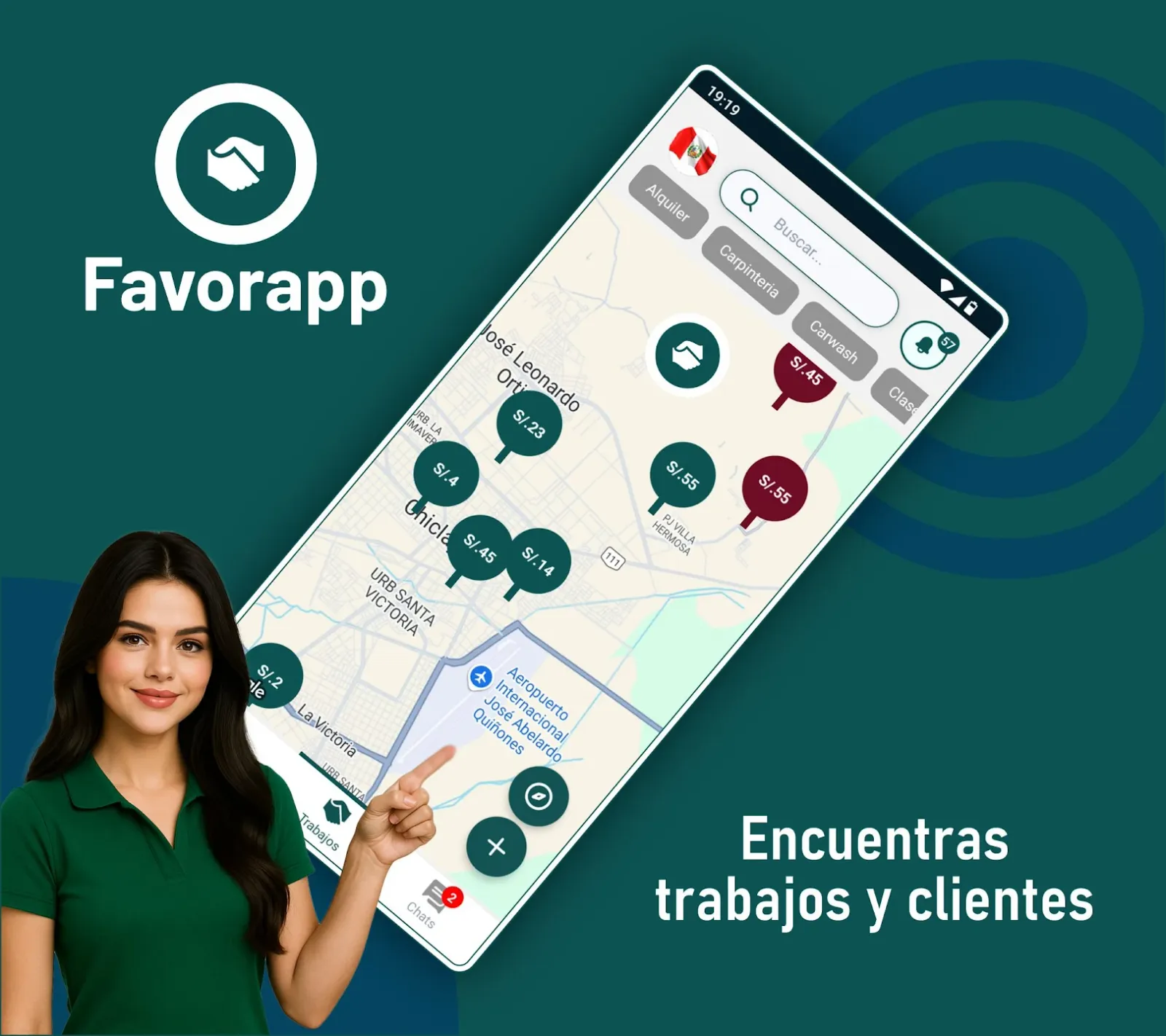
Connecting people who need a task done with people who have free time.
FavorApp needed a mobile app to post a task, find someone nearby on a map to do it, chat with that person and complete the payment without leaving the app.
A React Native app and 4 microservices in Go.
We developed the mobile app in React Native with reusable components, search with an interactive map and geolocation, token validation, push notifications and the full payment flow.
The backend is split into 4 microservices in Go: FavorAppApi (tasks and Cloudinary images), FavorappMessagingApi (WebSocket chat and Firebase Cloud Messaging), FavorappIdentity (authentication and users) and auxiliary endpoints to link chats with tasks and manage proposals.
What it includes
Complete mobile app
Reusable components, advanced search, an interactive map with geolocation and a task creation flow.
Real-time chat
Bidirectional WebSocket messaging in Go, with goroutines and automatic cleanup of inactive connections.
Push notifications
Firebase Cloud Messaging with token sync, delivery logging and auditing, and support for multiple devices.
Images on Cloudinary
Each task stores several images uploaded to Cloudinary asynchronously, without blocking the main API.
Microservices in Go
Tasks, messaging, identity and auxiliary endpoints, decoupled and communicating over REST.
Authentication and identity
User management with identity validation, initial balance, JWT tokens and sessions synced across services.
Stack and architecture
- React Native
- TypeScript
- Go
- WebSocket
- Firebase Cloud Messaging
- PostgreSQL
- Redis
- Cloudinary
- Mobile app
- React Native with TypeScript and native code in Kotlin and Objective-C.
- Backend
- Microservices in Go with a REST API documented in Swagger (OpenAPI).
- Real time
- WebSocket chat with goroutines and notifications through Firebase Cloud Messaging.
- Infrastructure
- PostgreSQL as the main database, Redis for caching, Cloudinary for images and Docker for containers.
What we solved
WebSocket chat in Go
Goroutines and connection pooling, with the HandleWebSocket handler refactored to automatically clean up inactive connections.
Notifications across devices
Firebase Cloud Messaging handling duplicate tokens, automatic per-device fallback and alerts built into chat messages.
Decoupled microservices
Idempotent REST APIs between services, cascade deletion of proposals, a link between each chat and its task, and Swagger documentation for every endpoint.
In detail
- Microservices in Go
- 4
- Available on
- Google Play