
AWS Lambda Web Functions: what changes when you deploy an HTTP application
AWS announced a Lambda mode for running conventional HTTP servers with Express, Fastify, or Next.js. Three infrastructure details and what I’d measure before migrating.
 Pool DezaFounder of IA Systems & Data1 min read
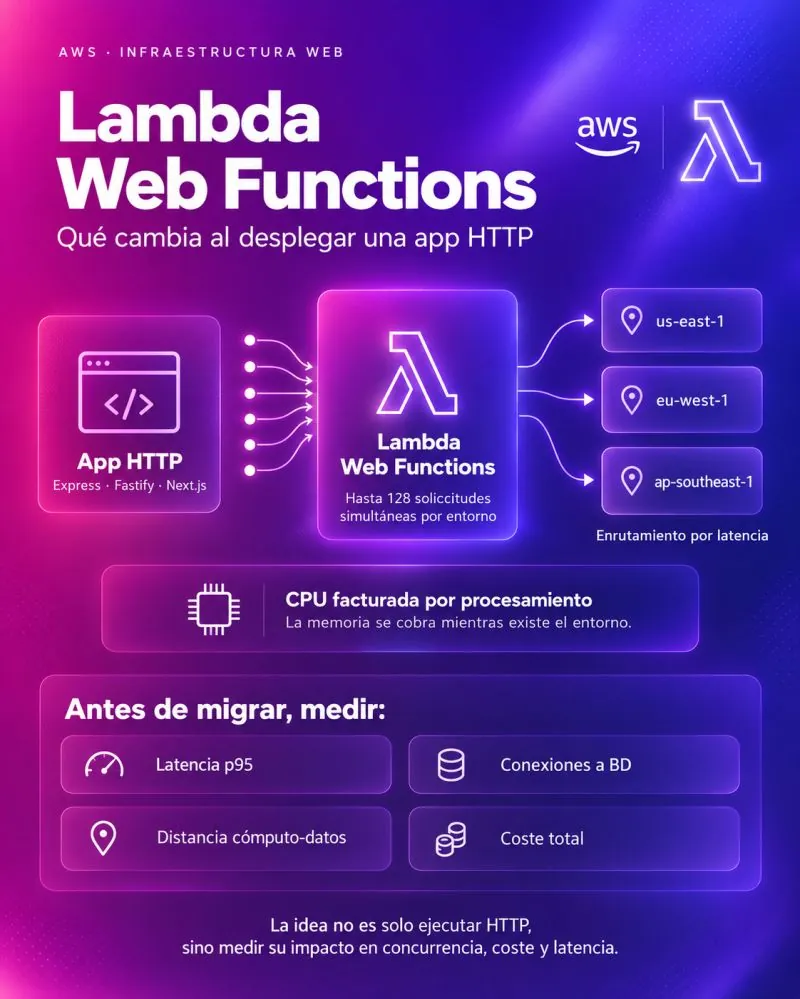
On October 12, AWS announced a Lambda mode for running conventional HTTP servers, including applications built with Express, Fastify, or Next.js.
Three infrastructure details deserve attention:
- Concurrency: one environment can handle up to 128 simultaneous requests.
- Active CPU: CPU billing reflects the processing actually used. Memory is billed for as long as the environment exists.
- Distribution: you can deploy code to multiple regions and configure latency-based routing (see the source).
To evaluate a migration, I’d measure:
- p95 latency under load.
- Simultaneous connections to the database.
- Distance between compute and data.
- Total cost under a representative traffic pattern.
Being able to share an environment across requests also means reviewing how we handle in-memory state and shared resources.
What would you measure first to decide whether this model fits your application?