Selling through Rappi or PedidosYa? Do the math on what the app keeps from every order
A 50-sol order. If the delivery app charges you 25%, it keeps 12.50, on every order. And that customer buys from the app, not from you. How to do the math with your own numbers and what your restaurant needs so that customers who already know you order directly.
 Pool DezaFounder of IA Systems & Data4 min read
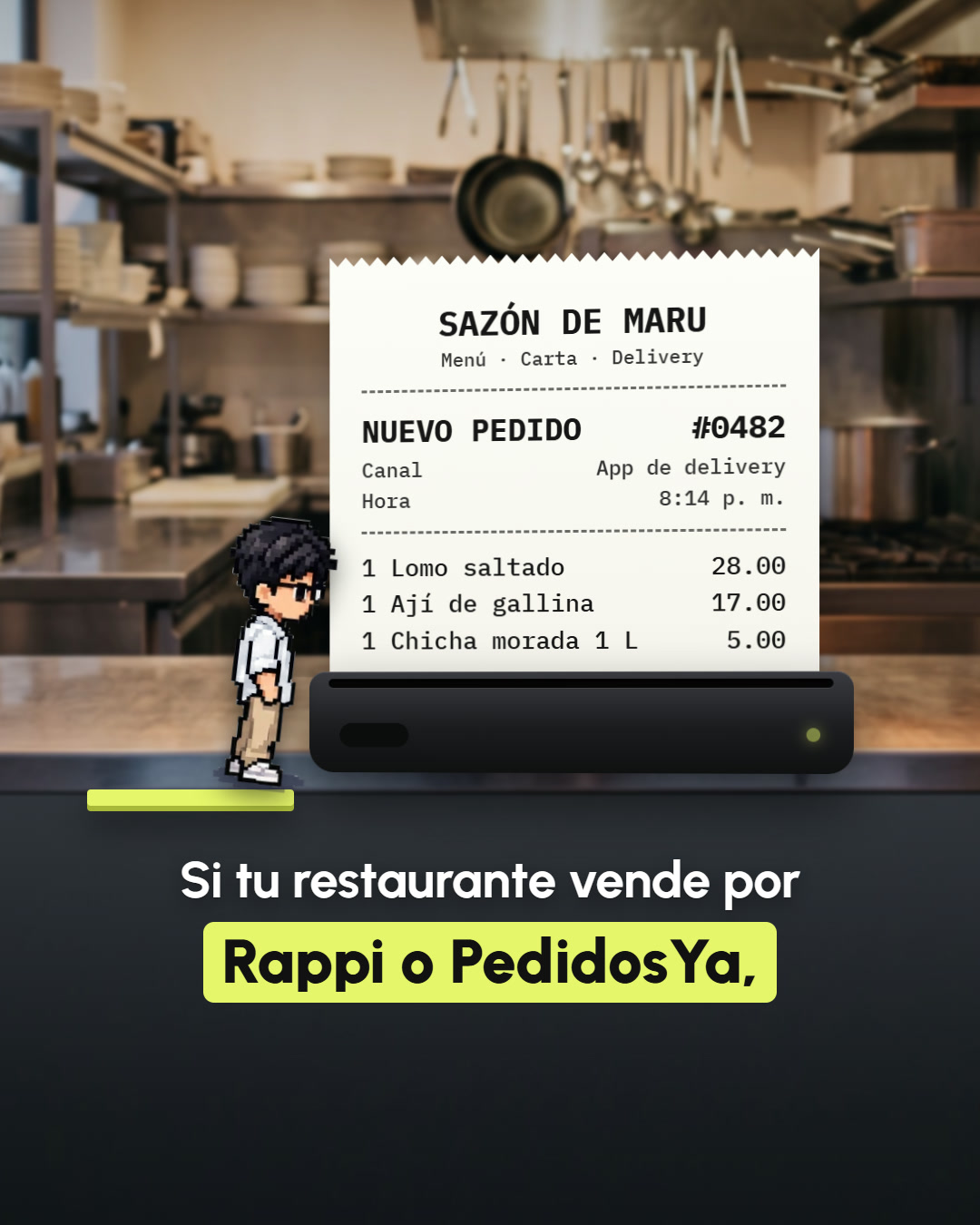
It is 8:14 p.m. and the kitchen printer goes off: a new order from the app. One lomo saltado, one ají de gallina and a one-litre chicha morada. Total: 50 soles.
That is good news. But before you celebrate, do the full math.
The math almost nobody does
Delivery apps charge a commission on every order, and each restaurant negotiates its own. For this example, let's use 25%:
| Item | Amount |
|---|---|
| Order | S/ 50.00 |
| App commission (25%) | − S/ 12.50 |
| You keep | S/ 37.50 |
Ingredients, packaging, staff and rent still come out of those 37.50.
Now multiply it. At 20 orders a day, that is 250 soles a day. Over a 30-day month, 7,500 soles.
Your commission may be different. This is how the math changes on a 50-sol order:
| If the app charges you | It keeps | You keep |
|---|---|---|
| 15% | S/ 7.50 | S/ 42.50 |
| 20% | S/ 10.00 | S/ 40.00 |
| 25% | S/ 12.50 | S/ 37.50 |
| 30% | S/ 15.00 | S/ 35.00 |
Do it with your own numbers: your commission, your average order and your orders per month.
The cost that is not on the receipt
You can see the commission. You cannot see the other cost: that customer bought from the app, not from you.
The app normally does not give you the contact details of the person who ordered. You cannot message them next week with a promotion or tell them the menu changed. And the next time they are hungry, the app will show your restaurant next to all the others.
This is not about leaving the apps
The apps do one thing well: they get you discovered by people who did not know you. That is worth something, which is why we do not recommend leaving them.
The problem is paying commission on the customer who already knows you: the one who orders every Friday, the one who lives three blocks away, the one who already knows what they want. That customer can order from you directly, if you give them a place to do it.
What your own ordering website needs
- Your menu, with prices and photos. Customers see everything without asking.
- Your cart. They build their order, see the total and choose delivery or pickup.
- The order reaches you instantly. Complete and in order, with no need to take it by hand over chat.
- Your customers. The name and phone number of each person who orders stay with you, so you can reach them again.
- Your brand. Your name, your colours and your web address, not the app's.
What your own website will not do for you
To keep the math honest, count this too:
- It does not bring new customers on its own. The apps, your social media and your ads still do that job.
- Delivery is on you: your own rider, a courier service or pickup at the restaurant.
- If you take online payments, the payment provider charges its own fee per transaction. Ask for the current rate before you decide.
How to move your customers to direct orders
- Give them a reason. For example, a small extra on their first direct order.
- Put the ordering link first on your Instagram, your TikTok and your Google profile.
- Reply on WhatsApp with the link instead of taking the order by hand.
- Invite them at delivery. A card that says "Next time, order from us directly", with a QR code to your website. Before you put it in orders that come through an app, check the terms of your contract with that app.
What it looks like in a real project
For a snack dark kitchen we built a website where customers see the menu, build their order in the cart, see the total and send it on their own. You can see more in our projects.
Watch the video
We tell it in 30 seconds on YouTube and on TikTok. The video is in Spanish.
What would your restaurant's ordering website look like?
Send us the word WEB from the contact page and we will tell you what yours would look like: which menu, which way of ordering and which way of paying suits your restaurant.